This report was compiled between 2505 and 2506. Sourcing: difficult. Personal bias: unavoidable.
I. Lost Sons
I have heard three versions of this story, and all three contradict each other on point four. That is almost standard for Terran history — a species that actively blurs its own origins, sometimes out of shame, sometimes out of political calculation, sometimes because the only surviving witness died in the next campaign. What can be told are the basic facts. Why things had to come to this hangs in large part on the psyche of one Dr. Doran Routhe, and honestly, few reporters want to read that file.
Four Ships, 40,000 Prisoners
The year is 2229. The United Powers League, at that time still the uncontested Earth government, has a problem — or rather, it has 40,000 problems with bodies attached. Convicts, dissidents, "social risk cases" in UPL vocabulary. What does a government do with people who do not fit the grid, when the prisons are full and public executions look bad on camera? It reinvented deportation, this time without a return ticket.
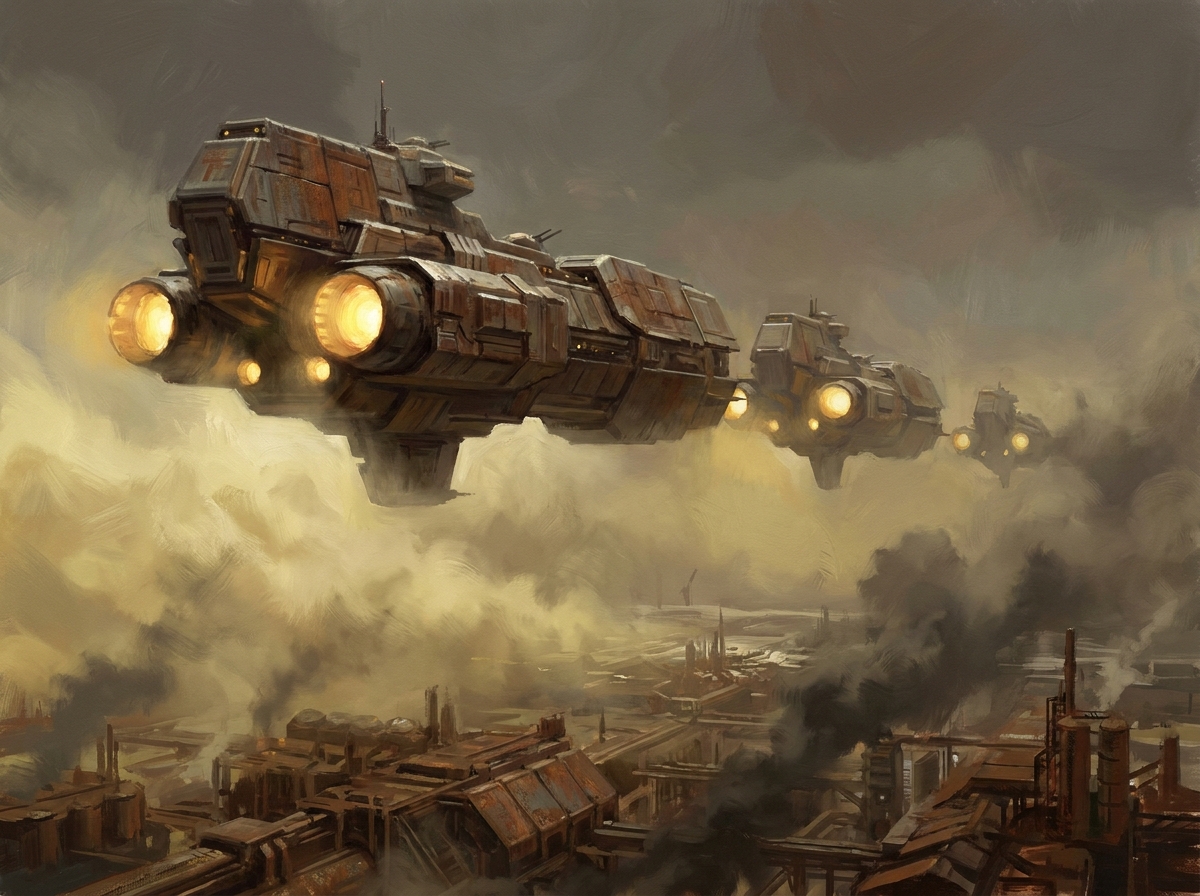
Dr. Doran Routhe, a UPL-aligned scientist with private laboratories and access to state resources, was the executing organ. Four supercarriers were loaded: the Nagglfar, the Argo, the Sarengo, the Reagan. Official destination: Gantris VI, a colonial project with infrastructure that existed at least on paper. Actual destination: somewhere else. The warp coordinates for both Gantris VI and Earth were erased from the navigation systems. According to the SC1 manual this was not a technical failure — Routhe’s motivation is not documented in canon, so no psychology will be invented here that cannot be proven. What remains is the fact: 40,000 people went to sleep not knowing that no one had planned the return leg.
Twenty-eight years in warp. An entire generation spent in cryo-sleep, which on Earth would have been the span between two world wars.
Arrival 2259
They woke up as founding fathers — in ruins.
The Sarengo broke apart on entry into the Umojan atmosphere. Around 8,000 people died on impact; the crater still bears the name Sarengo Canyon. The Reagan also came down on Umoja, the Argo on Moria, the Nagglfar on Tarsonis. That last data point is not incidental: the officers and commanders of the Nagglfar became the nucleus of what later entered the history books as the Old Families. Being on the right ship meant inheriting the future. Being on the Sarengo meant inheriting a crater.
The three landing sites — Tarsonis, Umoja, Moria — are no historical accident. They are the geographical bedrock of the three power blocs that will shape the Koprulu sector for the next 250 years. None of the colonies knew the others. None knew how many people had survived the trip. None knew that all of them came from the same planet and all had been dispatched there by the same man.
The Confederacy Is Born
It took until 2323 for Tarsonis to formally unite the other colonies under its roof. "United" is a charitable word for what actually happened. Tarsonis had held the largest ship, the most survivors with leadership experience, and — decisively — the best position between the colonies for controlling trade routes. The Terran Confederacy was never a democracy that indulged an aristocracy. It was an aristocracy that indulged a democracy because the optics were better.
Thirteen core worlds, a Confederate Senate, a Confederate Council — and behind all of it the Old Families, treating the rest as scenery. The Universal News Network, the outlet where this report will eventually be filed, was co-founded in the same era as a propaganda instrument. That is not mentioned here with pride, but it belongs on the table. Some institutions carry their birth defects with them a long time.
Guild Wars
The Guild Wars, which began in 2485 with the Battle of Noranda Glacier and dragged on for four years, are described in official Confederate sources as "security operations against criminal mining cartels". William C. Dietz documents a different version in Heaven’s Devils (2010): Turaxis II as a years-long war of attrition in which Confederate marines and Kel-Morian Guild Guards pounded each other flat until nothing was left but scar tissue and veterans too old to dream.
Two of those veterans were named Jim Raynor and Tychus Findlay. Both served in the 321st Colonial Rangers. Both deserted shortly before the war ended — Dietz supplies enough context to understand why. Raynor would later land on Mar Sara as a small-time crook turned marshal. Tychus would land in prison. The Confederacy won the war, founded the Umojan Protectorate as a consolation prize for the losers, and acted as if the matter were closed.
"We were loaded into cages labelled as colony ships, and woke up as founding fathers." — From a report that officially never existed; paraphrased from the SC1 manual.
II. The Iron Confederacy
The Confederate Senate met on schedule. There were elections, speeches, rules of procedure. There were even occasionally representatives who tried to change something. Most of them did not repeat the experiment — not because they were assassinated (mostly), but because the system was built so that real change was simply not on offer. Four Old Families — Bennet, Calabas, Terra, Tygore — controlled the economic chokepoints, and whoever controls the economy does not need to worry much about the politics.
Mar Sara was the eighth core world, the backyard of the backyard — a dusty frontier planet where people like Raynor were forgotten until they were needed again. UNN filed diligent reports from the central worlds, but there were no live broadcasts from Mar Sara. Not newsworthy.
Neural Resocialization
The Confederacy’s most effective instrument of control was not the military. It was not taxes. It was a medical procedure.
Neural resocialization — officially a reintegration programme for criminals and psychologically unfit soldiers — was, in plain terms, memory manipulation on an industrial scale. It was deployed during the Guild Wars to "stabilise" soldiers contemplating desertion. It was deployed afterwards to silence awkward witnesses, neutralise dissidents and return prisoners to duty with no memory of what had made them prisoners in the first place. Marines on stimpacks, with rewritten heads — that was not a regrettable side effect of the system. That was the system.
Carry that sentence with you to understand what comes next.
The Ghost Program
Psionics emerged from the Terran population with a certain statistical regularity. Humans with telekinesis, telepathy, precognitive ability — the Confederacy had a simple answer: recruit, train, deploy. The Ghost program was the institutional form of that answer. The Ghost Academy on Tarsonis, director Ilsa Killiany, a training system that turned children into weapons — implants guaranteeing control, memory wipes ensuring finished Ghosts had nothing but the program in their heads.
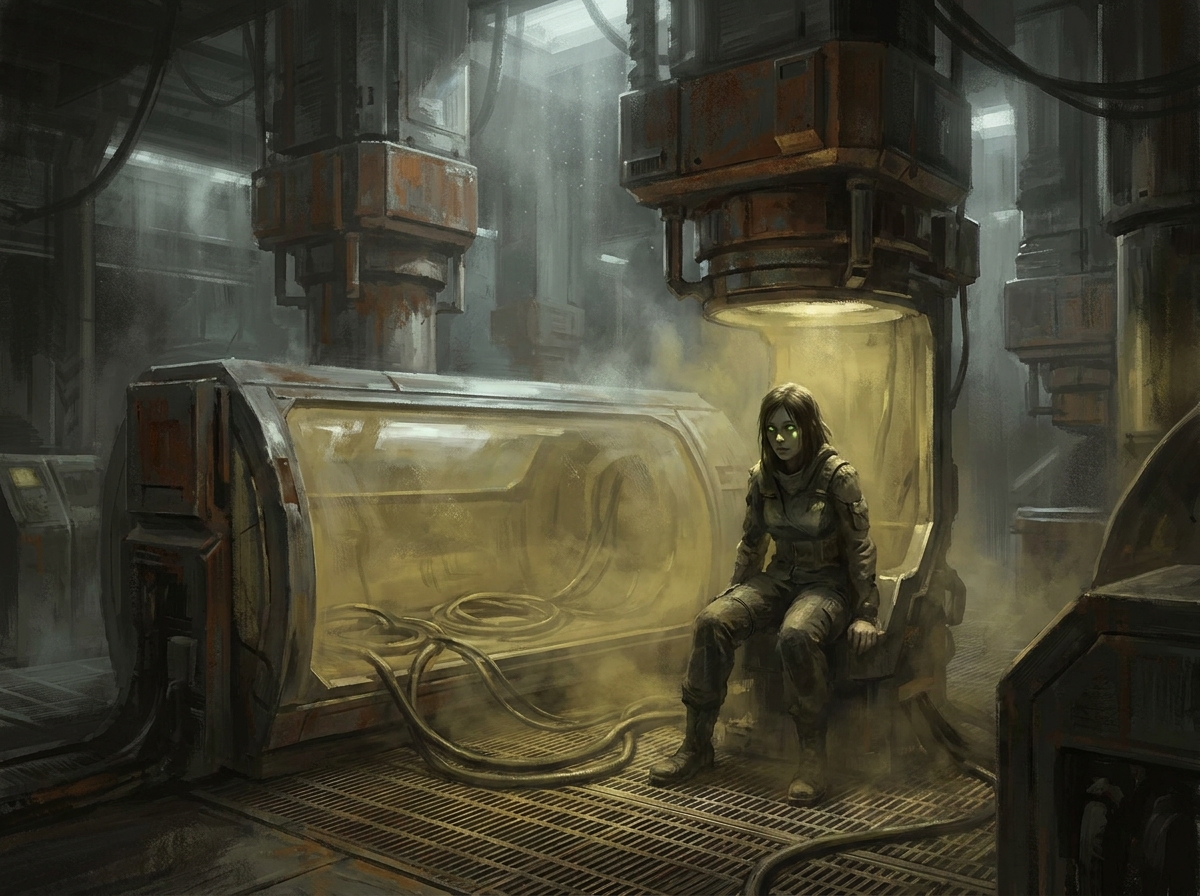
Post-training memory wipes became standard procedure after Kerrigan’s defection. Before that they were left to the instructor’s discretion. The logic is so cold it is almost elegant: a Ghost who remembers her family has potential loyalty conflicts. A Ghost without memories has none.
Kerrigan
Ghost number 24601. Sarah Kerrigan was recruited at age eight, after an incident in which her uncontrolled psionic powers killed her mother and left her father with permanent brain damage. According to Uprising (Micky Neilson, 2000) and the supplementary materials to I, Mengsk (Graham McNeill, 2008), her readings sat so far outside the norm that the existing Psi-Index scale had to be recalibrated. The Ghost Academy had never processed a psionic of that grade before.
What all of this meant for an eight-year-old who had just killed her mother and destroyed her father and was now being fed into a military program — the official record does not dwell on such questions. The Confederacy did not dwell on them. The girl was an instrument. Instruments are not considered; they are sharpened.
Nova Terra
For the argument that the system failed to protect even its own elite, there is Nova Terra. Old Family daughter, scion of the Terra line — one of those who by rights stood above the system. After the violent death of her family during the so-called "Gutter" incident, her mind briefly collapsed under the psionic shock; what remained of her became a Ghost. First for the Confederacy, later for the Dominion. No pedigree protected you from the program once the gift was there and the moment suited.
"The Old Families control everything from their capital world of Tarsonis, and the entire apparatus of the Confederacy is geared to keep them in power, exploiting the planets under their control and stealing their wealth. Well, no more." — Angus Mengsk, quoted in I, Mengsk (Graham McNeill, 2008)
Anyone trying to understand how Raynor’s rage and Mengsk’s vendetta could grow in the same decade should read Liberty’s Crusade by Jeff Grubb — the first novel to describe this era at eye level, not from the altitude of state archives.
III. Mengsk’s Fire
Angus: The Revolutionary from the Oligarchy
Graham McNeill, in I, Mengsk (2008), draws an Angus Mengsk who is hard to pin down: Old Family heir on Korhal, senator, one of those — and at the same time the most persuasive prosecutor against the system that had made him. Korhal was not Tarsonis. On Korhal people knew what it meant to be mined by the centre. Angus knew it too, because he had read the files.
What he did with that knowledge was still an open question in 2478. He founded the Rebellion of Korhal — not an armed uprising at first, more a political movement with thick rhetoric and genuine grievances. The Confederacy answered in 2478 with what you might call a corporate death squad if you wanted to be generous: the assassination attempt was foiled before it reached Angus. From that point on, the senator was a rebel.
Three Ghosts in One Night
2489. Three Ghosts broke into the Mengsk estate on Korhal. Numbers 24601, 24506 and 24718. Ghost 24601 was Sarah Kerrigan. According to Uprising (Neilson, 2000) she was the central operative — she was the one who severed Angus Mengsk’s head. Angus Mengsk died. His wife Katherine died. His daughter Dorothy died. The head of Angus Mengsk was never found.
Arcturus was not at home. He was prospecting at Pike’s Peak — one of those coincidental absences that write history. Juliana Pasteur, his partner at the time, and their son Valerian were living in hiding on Umoja. The Confederacy had killed three Mengsks. It would have needed four to close the account.
Arcturus Takes Over
What a man becomes when he learns that his own government has murdered his family while he was out prospecting ore — that is a question I, Mengsk spends more time on than any other source. Arcturus travelled to Umoja. He met his seven-year-old son Valerian for the first time. Then he took over the rebellion.
The renaming to the Sons of Korhal was a symbolic act, but in this line of work symbols are currency. More consequential was the hardware question: the Hyperion — a crashed Confederate battlecruiser that a navigation error had dropped into Umojan territory — became the flagship of the rebellion. The Umojans had secured the wreck, stripped out the tracking gear and paid the crew for their silence; Mengsk took the ship over in 2491. Pollock Rimes, originally the Hyperion’s commander, went on to serve in the Sons of Korhal — where, it turned out, he was a Confederate spy. Arcturus Mengsk now had a fleet. He had a target. And he had a catastrophe on which to build the rest of his life.
Korhal Burns
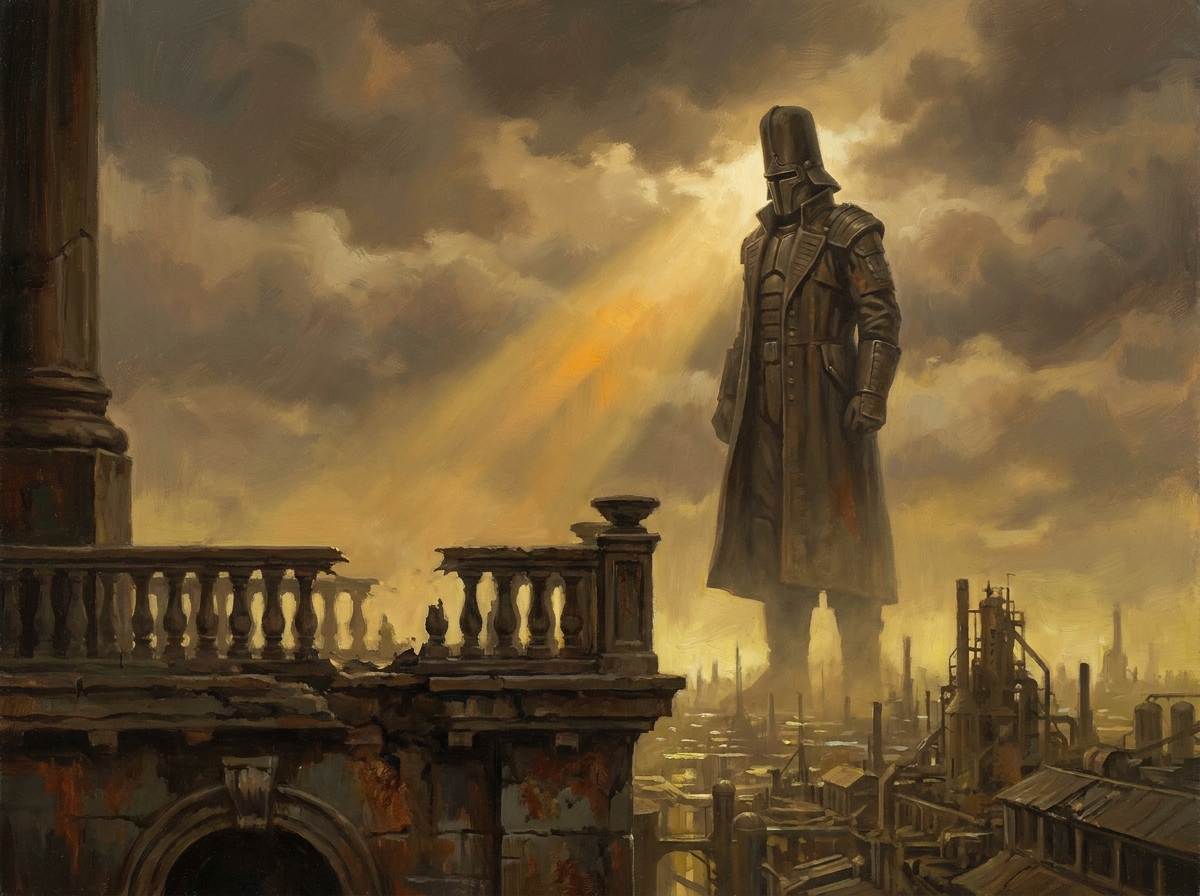
I have seen photographs of Korhal before 2491. They look like a different planet, because it was one.
In 2491 the Confederacy fired a thousand Apocalypse-class nuclear missiles at Korhal. According to the SC1 manual the planetary population was completely wiped out — millions dead, further precision is not solid in canon, and an invented figure has no place in this report. The surface became what survivors later called a "nuclear desert": black glass where the cities had been. Everything burned. Except Arcturus, who was on Umoja, and Valerian, who was still too young to grasp what he had lost.
This moment is the hinge. Everything Arcturus Mengsk did after this — the rebellion, the war, the coronation, the Dominion years that followed — traces back to Korhal 2491. That does not make him excusable. It does make him explicable.
Sons of Korhal
The Ghost Academy raid of 2491 was the first moment the Sons of Korhal stepped out of the underground and became publicly visible. Michael Liberty was among the handful of UNN reporters close enough to understand what he was seeing — and he had the rare gift of saying it out loud anyway.
"What you’re seeing is my own private little war, fought on my turf. Not cruisers and space fighters and marines but just words. And the truth. That’s my specialty. That’s my hammer. And I know how to use it." — Michael Liberty, from Liberty’s Crusade (Jeff Grubb, 2001)
Between 2491 and 2499 the Sons of Korhal ran a classic guerrilla campaign: strikes on Confederate assets, retreat, propaganda, recruitment. This was no longer a spontaneous uprising. It was a war of liberation with a media strategy. Arcturus understood that wars are not won only with battlecruisers.
Raynor Signs On
On 8 December 2499, Tassadar’s Protoss glassed Chau Sara. The Confederacy later labelled the strike a "decontamination measure" against alien infection — in reality the first hard proof that the Zerg threat was real and the Confederacy preferred to keep it under seal rather than warn the population. Mar Sara, the neighbouring frontier world, was placed under quarantine.
Jim Raynor was marshal on Mar Sara at the time. He did the obvious thing: he tried to protect people. The Confederacy arrested him for it. Shortly afterwards he defected to the Sons of Korhal. The circumstances of his release are described differently across sources — what matters is the outcome: from that point on Raynor led Arcturus Mengsk’s troops into the field, and he believed in what he was fighting for.
Hold that moment in mind when you try to understand what happens two years later.
Tarsonis and the Coronation
The fall of Tarsonis in March 2500 was Mengsk’s masterpiece and his damnation in the same stroke. The proof of concept ran on Antiga Prime: psi-emitter on the planet’s surface, Zerg swarms homing on the signal, Confederate troops overwhelmed. On Tarsonis, Mengsk repeated the pattern at scale. New Gettysburg. Psi-emitter. The Zerg came.
Kerrigan was deployed there with a ground unit. When the Zerg waves rolled in, Arcturus ordered a withdrawal — for everyone except her. "Arcturus, what the hell are you doing?" The answer was radio silence. Kerrigan fought until the chrysalis enclosed her. Tassadar’s Protoss fleet, which might have intervened, was itself overrun.
Tarsonis fell. The Confederacy ceased to exist. Three weeks later, in March 2500, Arcturus Mengsk crowned himself Emperor of the Terran Dominion — at the end of a war he had formally fought against imperial tyrants. The irony stands on its own.
Anyone who wants to read the full Mengsk story from the inside — the son’s perspective on the father, the doubling of dynasties — should turn to I, Mengsk by Graham McNeill. McNeill wrote Arcturus as a tragedy, not a villain biography. That distinction matters.
IV. Rebellion and Reconstruction
Brood War: The Ironic Rescue
The Brood War of 2500–2501 is chiefly interesting for Terran history because it briefly cost Mengsk everything he had just won — and because the man who helped him take it back was, of all people, Jim Raynor. It is hard to stop shaking your head: Raynor, who by that point knew what Mengsk had done to Kerrigan, ended up saving the man who had given the order, out of the hands of the United Earth Directorate.
The UED arrived from the Sol system under Admiral DuGalle and Vice Admiral Stukov — Earth had taken a short while to work out what was happening in the Koprulu sector and then dispatched a fleet to "stabilise" it. Stukov was murdered by Duran, which later proved to be part of a far longer manipulation. Korhal briefly fell under UED occupation. Mengsk survived — with Raynor’s help. The UED ultimately lost to a coalition that included Mengsk, Raynor and Kerrigan. Kerrigan installed herself afterwards as sole sovereign on Char. For what came next, nobody had a plan.
The Quiet Years
In the quiet years between the Brood War and Wings of Liberty, on which canon has little to say, the Dominion consolidated. Raynor’s Raiders operated as guerrillas on backwater worlds — no grand objective, no clean ideology, more a group of people too stubborn to quit. Valerian, now adult and carrying the title of Crown Prince, founded the Moebius Foundation. Official line: archaeological research. The actual agenda only surfaced much later.
Wings of Liberty
Tychus Findlay resurfaced in 2504 — out of New Folsom Prison, with a deal in his pocket that Mengsk had offered him and an exo-suit that never came off. The deal was simple: Raynor dead, freedom. Tychus arranged the Xel’Naga artefact campaign under false pretences. Raynor knew nothing of it.
What followed was a classic Dietz plot with a classic StarCraft ending: the artefact worked, Kerrigan’s infestation was reversed on Char, and then Tychus stood over her with a gun. Raynor shot his best friend to save a woman he loved and who commanded the Zerg. Counts as a victory, if you are feeling generous.
Heart of the Swarm and the Handover
Kerrigan came to Korhal. Arcturus was in his panic room, psi-shielded, safe — until he was not. The HotS cinematic "Ascension" shows him die, and it is less murder than consequence: a man who had spent years building a system that treated psionics as instruments, killed by the psionic he had sacrificed as an instrument. Valerian became emperor in April 2505.
His first structural reform: Ghost memory wipes from mandatory to optional. A small gesture, more symbolic than operational. But symbols are currency, as his father had taught him.
"Don’t go following causes. They’ll just break your heart. When idealism meets reality, it’s rarely reality that backs down." — Michael Liberty, from Liberty’s Crusade (Jeff Grubb, 2001)
The Wave 1 Bridge: Terran on the Tabletop
The StarCraft Tabletop Miniatures Game by Archon Studio renders the Terran chronicle in plastic. The Marine — conscript with a rewritten memory, stimpacks, C-14 Gauss Rifle — is Act II in miniature form: the end product of the Confederate machine. The Goliath came out of LarsCorp, saw service on both sides of the Guild Wars, and carried across every change of regime. The Marauder is Dominion-era: heavier, more aggressive, an export piece of the new order. The Medic is the quiet counterweight to the stimpack doctrine — without top-up there is no second wave. As a hero box, Jim Raynor with his Point Defense Drone rounds out the core. Siege Tanks, Wraiths and Battlecruisers are not in Wave 1 — when they ship is still open. The detailed rules briefing sets out what Wave 1 actually means on the table.
Epilogue: The New Sons
As of 2506: the Terran Dominion still exists. Valerian is emperor. Matt Horner is admiral of the Dominion fleet. The Raiders sit somewhere between unofficial guerrilla force and semi-official standing army — the line is blurred, as so much is in the Dominion. Umoja and the Kel-Morian Combine keep their distance. Nova Covert Ops and the "Defenders of Man" show that Old Family residue is still fermenting; the last chapter is not yet written.
After two years of research, the thought that stays with me is this: the Terrans have run through three forms of state in 250 years — colony, Confederacy, Dominion — and none of them was the one they actually wanted. Every new beginning built out of the ashes of the last. They have survived. A home that lasts longer than one generation, they have yet to find.
The Sons of the Confederacy have outlived the Confederacy. That counts for something. Whether it is enough will be decided by the next catastrophe.
Next in this series: a look at the faction that made more out of these ruins than any other — and, in doing so, stopped being what it once was. And after that: the oldest civilisation in the sector, the one that knows everything and still almost lost it all.
← Back to sector briefing ·
The Swarm — Anatomy of a Predator ·
Khala and Void — The Last Guardians