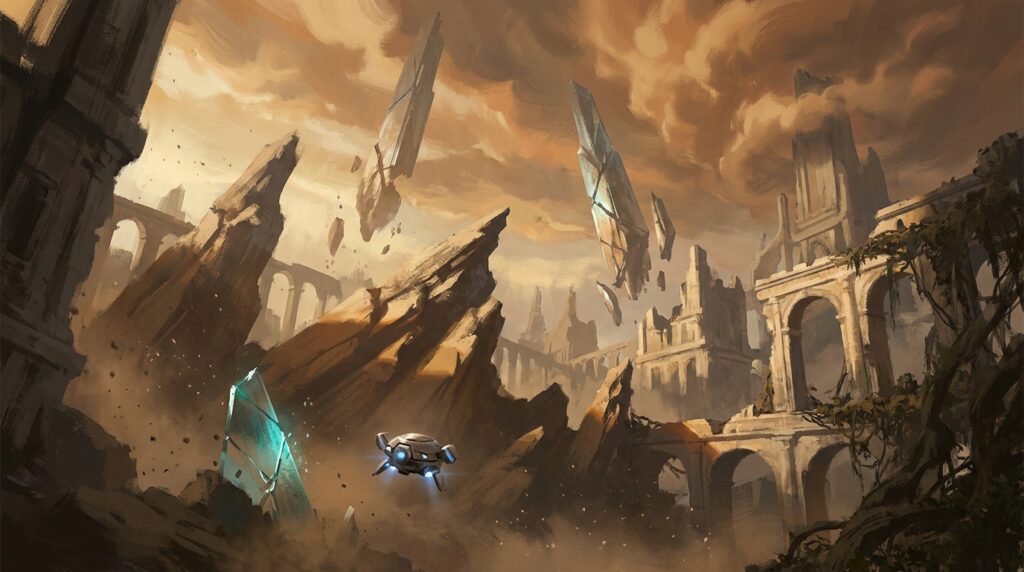
A Preserver of the Daelaam sets down these thoughts for the time after Khala. What is gathered here safeguards what can no longer be thought — not because it has been forgotten, but because the web through which it once flowed no longer holds. Whoever reads these words reads them alone. That is new for us. That is, now, the only thing we have.
The First Thought — Born of the Communion
The Hunters of Aiur
Before all else, we were hunters.
Not in the metaphorical sense, not as a figure for the martial temper that would later settle into the Templar caste — but in the plainest meaning of the word: tribes on a world who tracked their prey, who defended their boundaries, who mistrusted one another and who, nonetheless, when two of them stood close enough, sometimes felt the other’s thought. We had not learned that bond. It was simply there, as breath is, as heat is — a fact without authorship.
I am of the kind that carries the memories of the dead. I say this now, here, once: I know how it felt back then, when the bond had no shape and no name. Then I will fall silent for a while and let the chronicle speak.
The Intervention and the Revolt
Those who found us came with a name we would only learn later: Amon. One among them — not his species as a whole, but he, a faction within his kind who read the eternal cycle differently than the others. He saw in us what he took for completion: purity of form. The Firstborn. In Khalani, the tongue we would not yet have, we named ourselves Protoss — the firstborn. We did not know it then.
What followed was not a partnership. It was an experiment that never asked for consent. Over millennia — first in secret, then openly — Amon shaped what we became, and what we became was built for his purposes, not ours. When the intervention was complete, those who had found us withdrew: not out of respect for a finished cycle, but because we had struck. We had damaged their ships. We had killed hundreds. An experiment had bitten its keeper — and those among us who remained loyal to Amon he took with him. We would not find those others again for many ages. Those he took became something for which later speech had only the word „the Forged.“
What remained were the others. We.
The Millennium of Madness
The worst civil war ever recorded in this galaxy did not begin with a quarrel over resources, nor with a schism of belief, nor with the usual hunger of the mighty for more power. It began with a loss that felt like shame: the bond between us, that unnamed something which had let two tribes standing side by side feel how the other thought — it broke. Not because we had broken it. Because those who, without knowing it, had held it in order had gone.
What followed did not last an age. It lasted many.
The tribes tore at one another with a thoroughness that leaves even the coldest chronicler, reading the accounts, grasping for breath. The Mendella settlement at the foot of the great reservoir — its inhabitants flooded their own land, breached the dams, so that the rival tribe would have nothing to drink. No writings were set down, because no generation had time enough to learn writing. Technology that had been built over thousands of years rotted because no one still lived who understood it. Stone-age techniques were reinvented, within tribes that two generations earlier had crossed between stars.
In the midst of that madness there was a tribe called Shelak — and the others called them heretics, because they kept the artefacts of those who had found us and abandoned us. No piety drove them to it; it was closer to defiance. They did not understand what the stones meant. They simply did not throw them away.
Savassan, the Warrior Who Became Khas
His name was Savassan. A warrior of the Shelak, unusually ill-inclined to hatred in a time when hatred was the one thing everyone understood. Only his student Temlaa knew what he sought: the Xel’Naga inscriptions on hides, on stones, on anything that held. He was not looking for a god. He was looking for what had been lost.
He found it in a cave. Khaydarin crystals, dark and heavy, and when he laid a hand on one of the stones, something woke. Not at once and not completely — but it was there. What precisely bound those stones to what had once existed between our tribes, even the Preservers cannot fully explain. The bond was not in the stones. The stones only showed where it was: in us, asleep, deep, waiting.
The leader of his tribe, Telkar, wanted the crystals as weapons. Savassan refused. Temlaa pulled him from the cave when he fell too far into the sleeping bond and could no longer find his way back. What he brought from that near-death was not a revelation, not a religious system, not a doctrine. It was simply this:
„We do not need the Xel’Naga, we need only each other!“
— Savassan (later: Khas), as recorded in Dark Templar Saga #1: Firstborn (Christie Golden, 2007)
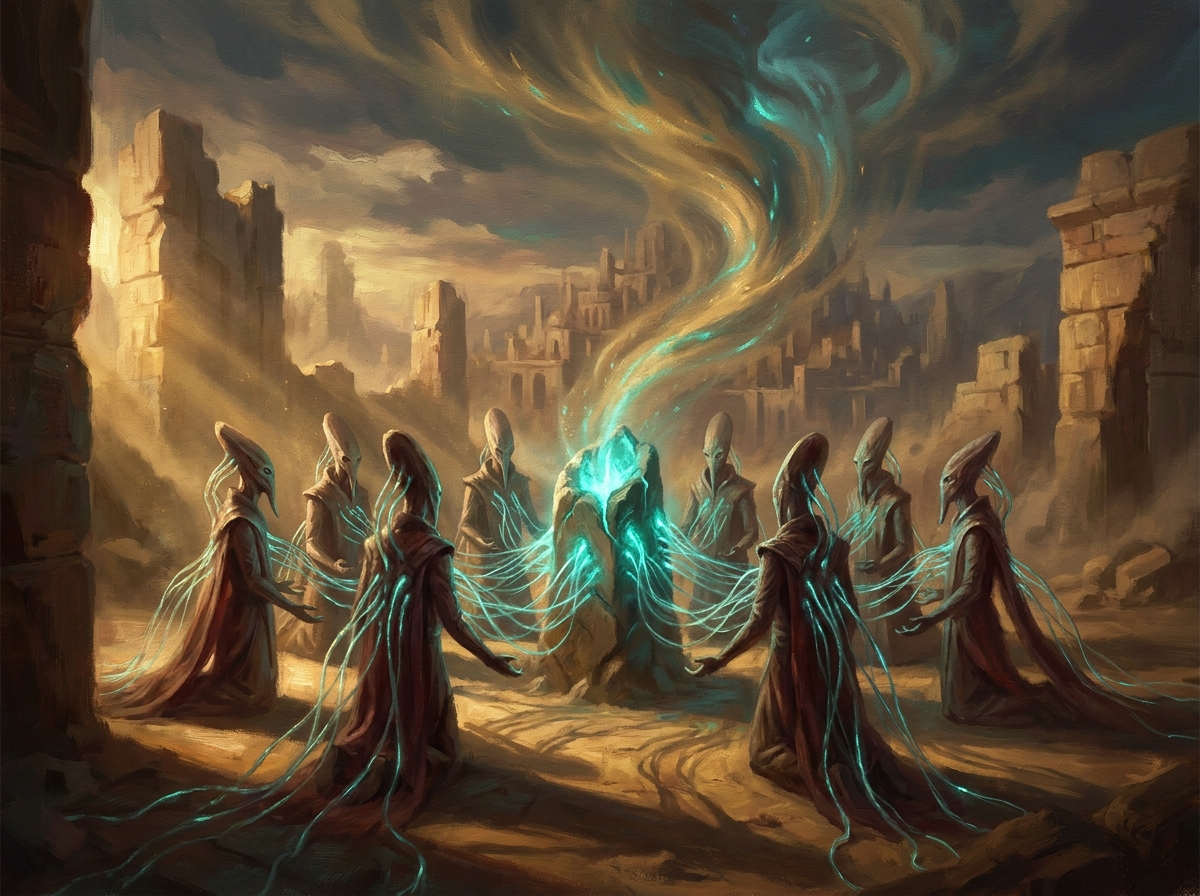
Savassan became Khas, the ordering one. He taught what he had found; he called it the Communion. The tribes learned it. The Gyras arena, in which only the week before they had thrown one tribe to another to be devoured — it burned once more, once was needed, once was what Khas would rather not have done. Then never again.
The Communion joined the Protoss. Out of the trauma of the Aeon of Strife an order rose: the Judicator caste, the Templar, the Khalai — each in its place, each bound. Khas died at a great age, the way one dies who finishes work and then lets go. His spirit passed into the Communion. He is there still — an echo one can feel, if one is quiet enough.
Was quiet enough.
The Second Thought — The Silence Between Us
The Second Age and Its Shadows
After the Strife came the Communion — and with it a world that learned to think in concord. It was neither a religious peace nor a political compromise, but something stranger: a shared stillness after the noise. The Protoss built again. They travelled to the stars. They practised the Dae’Uhl — that principle of great stewardship over younger peoples, born from the knowledge of having once needed shelter themselves.
The Communion — in that time they gave it the name Khala, which we have used ever since — was not a simple tie. Nerve cords in the body carried the psionic current; a bond that could be loosed only by physical severing or by certain means. The dead did not leave it wholly: they left resonances, echoes, less than full selves but more than memory. Preservers could call those resonances back in full. That was our office, and that was our weight.
It was an age so long that the Protoss began to take it for given. And the things one takes for given are those one does not fight for, until they are gone.
Those Who Would Not Follow
There were some among us who refused the Communion.
Not a single tribe, not a coherent movement — rather a minority drawn from many different tribes, for whom the question was not whether the Communion was good, but whether the self vanished within it. They believed — and they were not wholly wrong — that the Judicator Conclave used the Khala to smother each dissenting thought in the moment of its rising. What was bound into the Communion could hide nothing. What could hide nothing could not resist.
They called themselves Nerazim — the name chosen by those who kept their bond in another way: they severed their nerve cords. Not by another hand, not under compulsion — as ritual, as refusal, as declaration. From then on they drew their strength from the Void, that other force which existed alongside the Communion and which the Khalai would rather not have named. We, the others, called them Dark Templar. Both are right. Both are canon. Their own name first.
The Conclave answered as conclaves answer dissent.
„There are some among us who would destroy everything we have sought to build… They question the Khala. They maintain that the right of the individual takes priority over the good of the whole.“
— Judicator Kortanul, Dark Templar Saga #3: Twilight (Christie Golden, 2009)
Exile was the mildest possibility. Annihilation was the other.
The Executor Who Disobeyed
Adun. He was Executor — Templar, not Judicator — and stood at the side of his superior Zorani as the driving figure of what the Templar caste showed to the outside world: resolve, obedience, the willingness to carry out hard orders. The Conclave gave him the hardest. He was to end the Nerazim. In silence, without notice, before the matter grew.
He found Raszagal, still a youth then, in a mind-meld — the last contact the Khala-bound held with those who stood outside. He questioned her, extensively. And then he stood with the knowledge of what he was meant to do, and with the knowledge of what he would do. They were not the same.
„In my heart… Raszagal is not a threat. I have questioned her — extensively. Nothing in her desires revolution, or disharmony. She merely wishes to keep herself to herself. Is that worthy of death?“
— Adun, Dark Templar Saga #3: Twilight (Christie Golden, 2009)
He taught them, instead, to hide. The Nerazim learned to disappear into the light, to weave shadow, to lean into the Void until they were unseen. They learned faster than Adun could teach.
It came undone, as such things come undone: through an error in a moment of danger. Psionic storms that Adun could not fully govern betrayed his disobedience. Kortanul’s fleet came. Adun then joined what no one had joined before: Khala and Void, in a single act that veiled the Nerazim behind a blue mist — and that extinguished him as a star extinguishes when it explodes and is then no longer there. No death in the usual sense. No passage that made itself felt within the Communion. He was gone. Completely.
The Conclave lied openly: Adun had been mystically parted from them after erasing the Dark Templar blemish. The Nerazim knew what had truly happened. They carried it within themselves. That is why Templar say to this day En Taro Adun — „in honour of Adun“ — and Nerazim say Adun Toridas: „may Adun grant you refuge.“ The one phrase honours his name. The other remembers what he did.
Christie Golden’s Dark Templar trilogy — Firstborn, Shadow Hunters, Twilight — is the fullest source for Adun’s story and for those who came after him: Zamara, a Preserver whose memories were later transferred to a mortal archaeologist on Nemaka in a manner that nearly cost him his life. The trilogy on Amazon is the most direct road to this material.
Shakuras, the Twilight
The Nerazim took refuge first on the moon Ehlna, then on a desert world of ebony stone whose two moons cast almost no light: Shakuras. An eternal twilight. Its capital, Talematros. Their biology adapted across generations to the dark. Their Warp Blades were forged aboard the Xel’Naga exile-ship Adun had left them.
Raszagal became Matriarch. She would remain so for roughly five centuries, until the time of which this thought does not yet wish to speak.
On Aiur the Conclave hardened its rule, as though the exile of the Nerazim were a warning and not a failure. Caste boundaries grew stricter. The Preservers — my kind — held no mandate and no power. We could offer memory, we could not command. „They could offer only information,“ so the records say, „and could not give orders.“ So it remained. That, in a sense, is still so.
The Third Thought — Storms From Without
The Coming of the Strangers
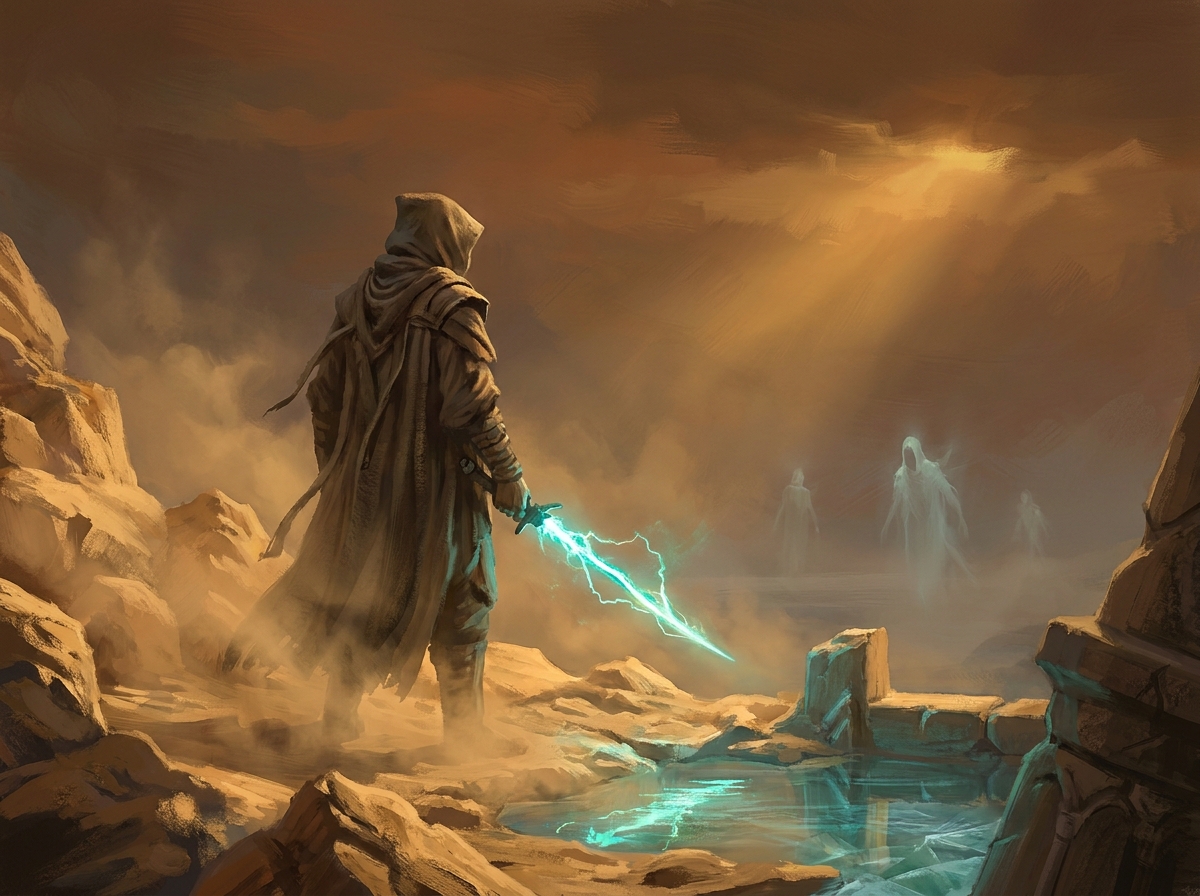
The Swarm came out of the dark without warning. Not as an enemy in the sense the word had for us — not as individuals with hatred or greed or ambition, but as a cosmic event. As hunger at great scale. We called them the Swarm, and that was the only name that fit.
The first world on which they settled was not ours. The mortals of the far sector. The young ones, who had barely outlived their own brief history. The Conclave commanded the one thing the Conclave could command: Purification. The glassing of worlds already taken. Clean, technical, without distinction between what had already fallen to the Swarm and what was only trying to live.
Tassadar, Executor, led the fleet. He obeyed — and he doubted. Not quietly, not in private, but with the hesitation of one who knows he is doing the wrong thing and does not yet know how to stop.
„Though I grieve for the loss of every Terran life on Chau Sara, I fear that many more of your kind will die if the Swarm’s rampage is not stopped.“
— Tassadar to Colonel Andre Madrid, StarCraft: Revelations / SC1 (1998)
Grief for the killed. And onward nonetheless. That was the dilemma Tassadar bore, and it was no dilemma of the Khala — the Khala would have thought it away — but his alone.
The Bond on Char
On Char he met Zeratul. A Nerazim, one of those outsiders who had stepped from the Communion, and who yet turned upon the same enemy. Zeratul killed Zasz, one of the Swarm’s Cerebrates — and through the psionic feedback he had not reckoned with, the Overmind that governed all of it learned where Aiur was.
That was an accident with the weight of a decision.
Zeratul said to Tassadar what he thought of him:
„You have learned to channel our dark power as well as that of your masters; thus, you alone have found completeness beyond the scope of the Khala.“
— Zeratul to Tassadar, SC1 (1998)
That was foreshadowing the Swarm did not understand. That was also the prelude to what would come on Aiur.
The Arrest, the Rescue, the Break
Aldaris had Tassadar arrested — for disobedience, for his bond with the Nerazim, for everything he represented: the possibility that the Conclave was wrong. Artanis, Fenix, Zeratul, and the mortals under Raynor freed him. On Aiur, Protoss fought Protoss while the Swarm landed.
Aldaris said to Tassadar: „Ah, Tassadar, have you fallen so far? To think that you were our brightest hope; our most beloved son. Now you are everything that we are not. You are lost to us.“
Tassadar answered: „Such is the price for our race’s salvation, Judicator!“
Fenix fell in the first assault as a Zealot — his body the Templar afterwards raised into a Dragoon shell, not from duty but because he asked it. He fought on, in that new, cumbersome body, with a dry remark on his condition: „Well, after my unfortunate defeat, my ruined body was recovered by our brethren. I now reside within the cold, robotic shell of a Dragoon.“ Fenix remained Fenix, whether flesh or steel. His second and final death came later, on a world called Korhal, through a betrayal that did not come from without.
The Sacrifice of the Gantrithor
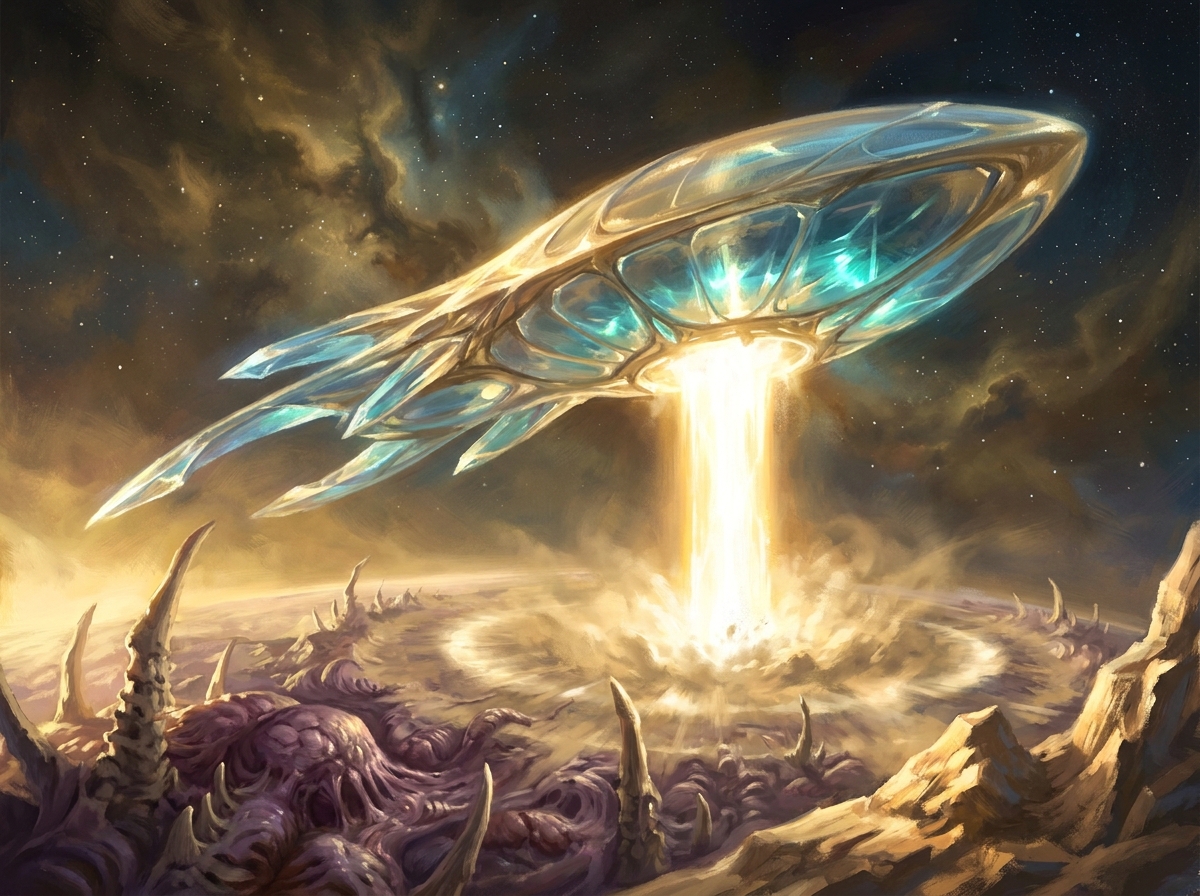
The Overmind buried itself in Aiur. A planetary threat rooted in the soil of the home world. Tassadar led the Gantrithor — and joined what Adun alone had joined before him: the energy of the Khala and the energy of the Void, united in a single act. Adun had turned it upon himself. Tassadar turned it outward.
„My friends, this is our final hour. Not all of us may survive the coming conflict. Yet, death may be a blessing should we fail here.“
Then, just before the end: „Aiur shall not fall! Executor, I stand ready!“
The Gantrithor and the Overmind and Tassadar — all at once. The released energy drove through the Zerg planetary crust like a column of light. Not an impact, not a simple suicide — a channelling, a redirection of all he was, through the ship, onto the target.
Those who were bound to the Khala felt his last thought as a cut. We carry it within us. This, here, is a part of it.
The Overmind was dead. Aiur had fallen. A great part of the Protoss population was no longer alive. The precise figure stands in the timeline, where figures belong.
Shakuras and the Lie
The Warp Gate flight. Shakuras. The Nerazim saved the Khalai refugees from the first ambush — without obligation, without treaty, out of a kind of quiet decision that needed no explaining. Two Khaydarin crystals, Uraj and Khalis, joined in the Xel’Naga temple, cleansed Shakuras of the last Swarm forces in a detonation no one had quite planned.
Raszagal had long since ceased to be herself.
Aldaris discovered it last, too late. She had been that way a long time. Aldaris saw it. Kerrigan killed him for it.
The Matriarch Raszagal — roughly five centuries of rule, survivor of the exile, the woman who had known Adun’s face — was Kerrigan’s puppet, and had been before the refugees arrived. Zeratul saw it, acted, killed her. Not as policy. Not as strategy. As the only thing left to her.
Raszagal said, before she died: „Thank you, Zeratul… You have freed me from her vile control at last. … Into your hands I give the future.“
Zeratul answered Kerrigan: „Better that I killed her, than let her live as your slave.“
The Daelaam Rises
From the collision of Khalai refugees and Nerazim hosts came not peace, but something more useful: a community of necessity that became an order. Khalai and Nerazim joined under the name Daelaam. Artanis became Hierarch. The Golden Armada was built on a planet they stripped bare in the building.
Raszagal’s legacy was not bright. It was workable: she had taken the Khalai in. On that one could build.
Then came a moment in which the Daelaam learned that a third Protoss faction still existed. The Tal’darim — those Amon had taken during the Xel’Naga withdrawal, his Forged, raised in the tradition of his service: no Khala, no Nerazim path of Void schooling, but Terrazin and Amon-worship and a hierarchy called the Chain of Ascension, in which any could challenge the one above him if he believed he could kill him. Redder than anything else — red blades, red eyes, red rage. They had a Highlord named Ma’lash, and they had someone beneath him, waiting for Ma’lash until the hour came.
His name was Alarak. That will matter.
The Fourth Thought — The Last Harvest
The Prophecy That Was Not
Zeratul found prophecies on the world Ulaan. Fragments which the Preservers on Zhakul read out. They said what no one wanted to hear: that Kerrigan could not be allowed to die. That something greater was coming, for which she was needed.
Then Tassadar appeared. Not truly — Ouros, one of the last guardians of the Infinite Cycle, in Tassadar’s form, because that was the form Zeratul could bear. Ouros said: „I have never tasted death, Zeratul — nor shall I.“ A last teacher in a borrowed face.
Our last teacher wore the face of our greatest dead. That was a kindness.
The Betrayal of the Khala
Artanis opened Operation Reclamation. The Golden Armada. Aiur, to be retaken. That was the plan, long enough held, long enough prepared.
Amon returned. Not in a body. In the Khala itself.
He had no body — he needed none, because he had never been in one that was his. The Khala had been his experiment from the start, since Khas had raised it from the Khaydarin inheritance: a web he could still touch, if he returned to it. Every Khalai who was bound became his puppet. The Golden Armada turned its fire on itself.
Artanis fled to the ship once named for Adun — the Spear of Adun, the first arkship, which Adun had never set foot on himself. Rohana was aboard. The last Preserver among the Khalai, who had refused to sever because the Communion was her core. Until Amon made a puppet of her, too. Then she severed also.
Selendis, High Executor of the Golden Armada, asked Artanis:
„Without the Khala, what will we become?“ — „Free.“
— Executor Selendis and Hierarch Artanis, SC2: Legacy of the Void (2015)
The nerve cords were severed. Collectively. By choice. The Communion which Savassan had raised from the trauma of the Aeon, which had held for three and a half millennia, which carried the dead and joined the living — went dark. In a single cut. So that Amon should have no host.
Freedom and mutilation, in the same cut.
Zeratul died by Artanis’s hand while Amon was still in him. His last stroke severed Artanis’s nerve cords and freed him. The Warp Blade hand remained. Artanis wears it.
„My life for Aiur.“ That was Zeratul’s epitaph, and it was whole.
Shakuras broke. Amon opened the Xel’Naga Warp Gate on the planet’s surface and overloaded the temple. Vorazun, Matriarch of the Nerazim after Raszagal, stood by and said afterwards: „Shakuras is gone. It has become one with the eternal night. But the traditions we forged there will remain with us forever.“
The Alliance of the Shipwrecked
What followed was not beautiful, but it worked. The Daelaam, the Tal’darim under Alarak — who had killed Ma’lash in an ascension rite, as was his right, and was now Highlord — Purifier units, Zerg under Kerrigan, Dominion forces under Valerian. Ulnar first: there they found what the prophecies had hinted at, that Amon had already killed the Xel’Naga long before anyone thought him returned. Ouros was the last. Kerrigan absorbed him and became what Amon had wanted to become.
Amon was defeated in the Void. That was the end. It was also a beginning.
After the Harvest
The Protoss without the Communion.
Some Khalai woke and suddenly had no friends — not because the friends had gone, but because the channel had gone, through which friendship between Protoss had always been felt, not merely known. Some experimented with technologies meant to replace the Communion. Some of those experiments ended in death. Timothy Zahn’s novel StarCraft: Evolution tells how, in the years after the End War, Khalai woke suddenly alone, with hands reaching for bonds that were no longer there.
Rohana helped with the rebuilding. She knew all that a Preserver can know — every resonance of the dead, every name ever handed to her. She only had no Khala any more, through which she might have shared it. What I carry, I carry now alone. It is the same with her.
Artanis has sought a unity that needs no Khala. A conscious choosing to be with one another, in place of an involuntary bond. Whether that can hold — not enough generations have passed yet to know.
Epilogue — Aftersound
I am of their kind. I carry the names of the dead within me — Tassadar, Zeratul, Raszagal, Adun, Khas, all the others, all who have gone and whose memories have found their way to me. I am alone with them now. The Communion is not there any more that would have made them accessible to all.
Rohana bears the same. All of us who remain of our kind bear the same.
I write it down because the Communion can write no longer. After me there is no voice all can hear. After me there are only readers.
On the Second Front
At tin scale, the Daelaam is taking shape. Zealot, Sentry, Adept, Stalker and the Pylon are locked in; Artanis leads them, Zeratul arrives as a promo model and will receive his rules in summer. Summer brings the Immortal, the High Templar, and Tassadar as a hero. October brings the Scout — firmly dated on the current roadmap; toward year’s end the Dragoon, tentatively slated for December. Dark Templar, Archon, and Corsair are confirmed without a date. The Tal’darim carry their own names onto the sprue: Havoc, Supplicant, Vanguard, Blood Hunter. The Purifier line: Legionnaire, Conservator, Mojo. Heavy units like the Carrier, per Archon’s statement, are explicitly not planned for the initial release cycle — the model would be too large at play scale; whether and when it follows remains open. The rules that hold all of this together are set out elsewhere: in the rules deep-dive.
Back to sector briefing
·
Sons of the Confederacy
·
The Swarm