Three species. One sector. And a single date — 2500 by Terran reckoning — at which everything came apart at once. Any commander placing a StarCraft Tabletop Miniatures Game figure on the board today is dropping it into a conflict whose roots stretch back millions of years and whose consequences still shape the Milky Way. This briefing reconstructs what came first — so the events on the game table stop being cliche and start being consequence.
I. Before Humans Arrived
Wanderers Out of the Void
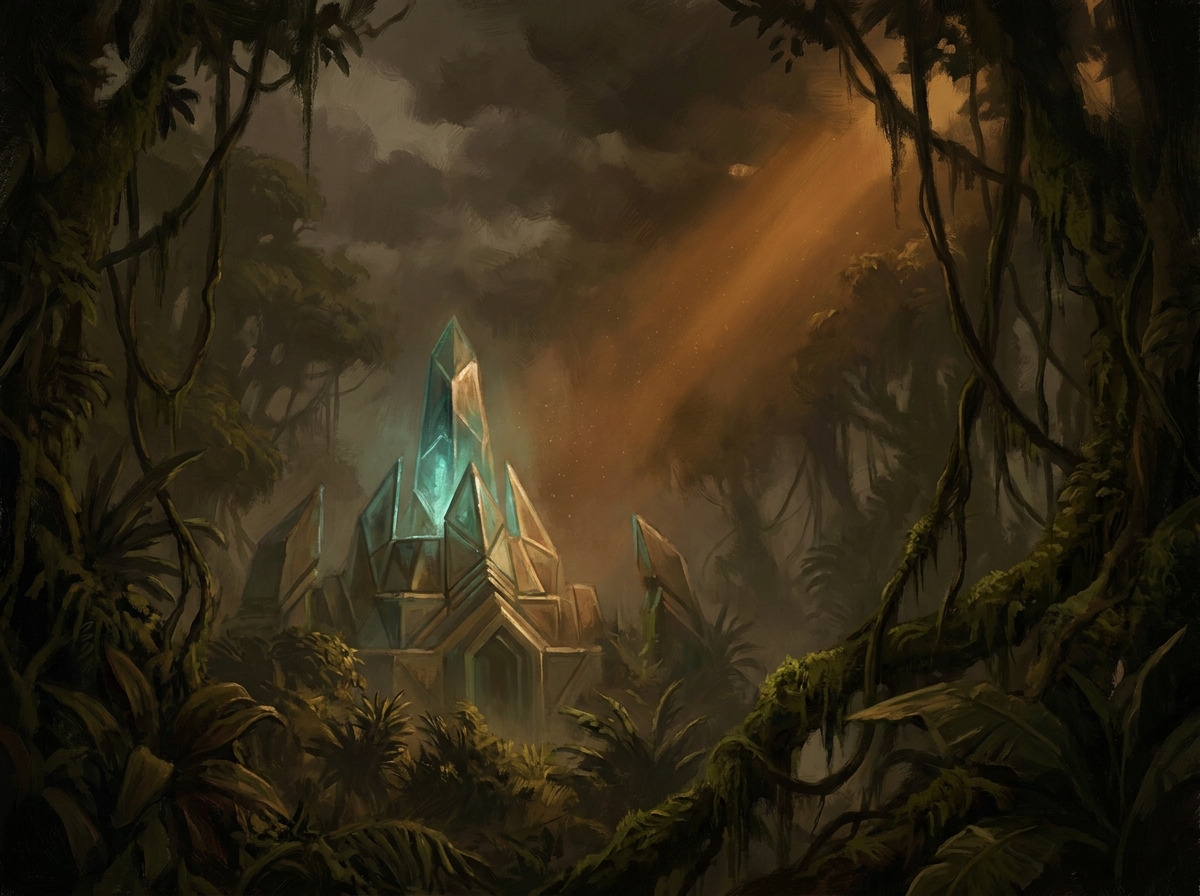
Long before any Terran supercarrier fired up a warp drive, the Xel’Naga moved through the galaxy — not as explorers, but as breeders. The StarCraft Field Manual (Insight Editions, 2015) records their cosmic pattern — the Infinite Cycle — as the organising principle behind everything they did: a mature Xel’Naga civilisation shapes two species, one after the other, and folds them into an instrument for regenerating the universe. The model worked, right up until one of them refused.
The Protoss called them „Ihan-rii“ — great teachers. The title fit the facts. They brought knowledge and intent. What they brought was not always benign.
„a highly advanced race of god-like entities originating from the Void“
StarCraft I Manual (1998)
The Schism — Amon Against the Cycle Keepers
The rift began with a refusal. Amon — a Xel’Naga whose name was only fixed in the millennia after his defeat — did not want to continue the Infinite Cycle. He wanted to replace it. His vision: a universe without imperfection, without the friction between species and civilisations. What sounds like utopia was annihilation by design. He broke from the main Xel’Naga line, first inside the sacred Xel’Naga temple of Ulnar suspended between dimensions, then in open war — the War Among the Gods, which destroyed most of Xel’Naga civilisation. Amon’s body was destroyed; his consciousness remained bound to the Void. Consciousness in the Void, however, is not empty space.
Before the war reached him, Amon had already set two experiments in motion. Those experiments are still alive today.
Aiur — Purity of Form
The Protoss emerged on Aiur through direct Xel’Naga intervention: selection, modification, awakening of a collective mind. The goal was „purity of form“ — a physically perfected species that would carry the cycle forward. For centuries it worked. The Xel’Naga observed, taught, withdrew as Protoss pride grew. What followed was the Aeon of Strife — a phase of internal wars that pushed the Protoss to the edge of extinction. The Khala, the shared psychic bond that pulled them out of that crisis, became the social foundation of an entire civilisation. How tragic that dependency was comes clear later in this briefing.
Zerus — Purity of Essence
The second experiment ran on a different principle. On Zerus, Amon’s renegades bred the Zerg: parasitic, assimilating swarm organisms engineered toward „purity of essence“ — biological perfection through endless absorption of other species. Where the Protoss defined identity through form, the Zerg defined identity through merger. The Overmind was built in as a control authority to neutralise the obvious danger. A swarm that feeds in every direction without central guidance serves no plan. The irony of the experiment is plain: Amon built the Zerg after the Protoss, as a corrective to the ego-flaw of the first attempt. Both species therefore carried Amon’s design error from the start. Neither knew it.
II. The Terrans Reach the Sector
The Exodus — Who Loaded the Supercarriers
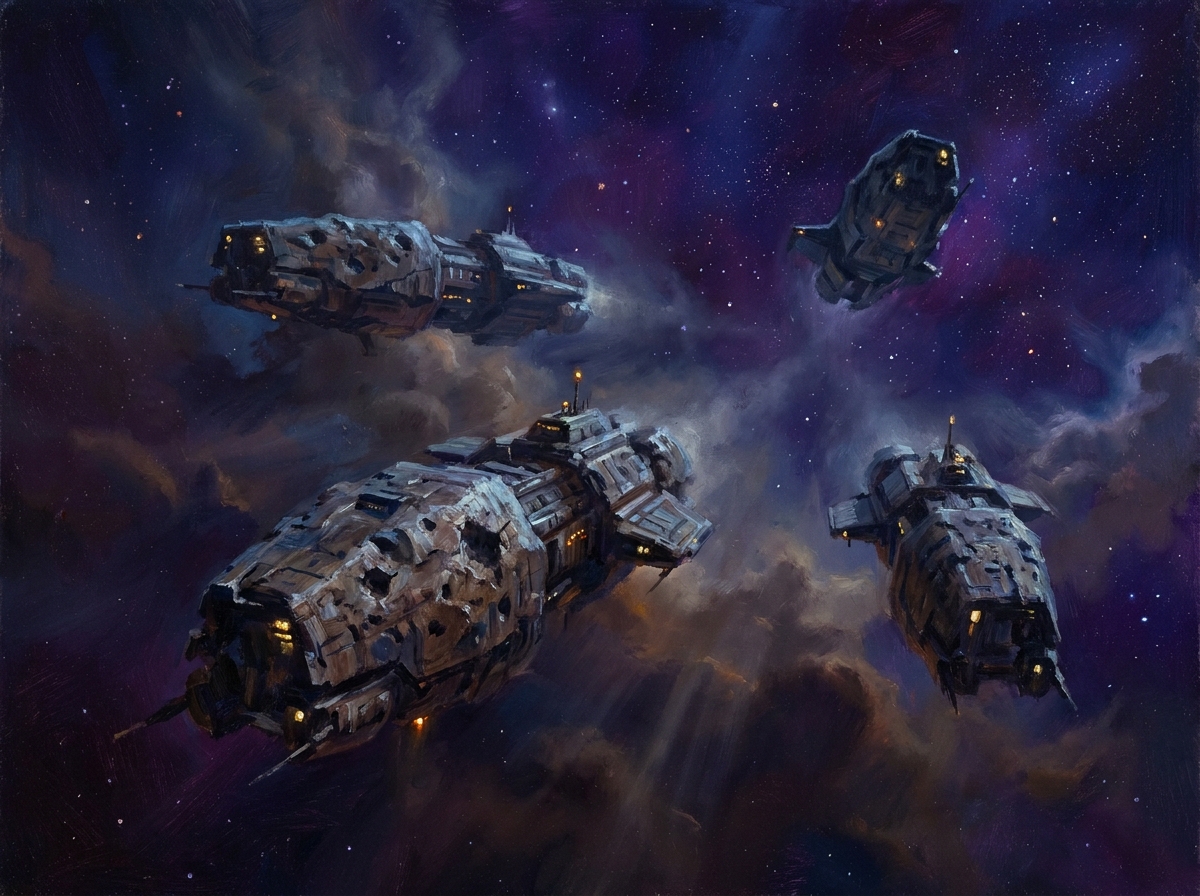
Millions of years after the Xel’Naga experiments, in the year 2231 by Terran reckoning, the United Powers League on Earth approved a relocation programme of a particular kind. Dr. Doran Routhe — scientist on state payroll, with privately funded labs — loaded four interstellar supercarriers with 40,000 humans: convicts, political undesirables, test subjects. Stated destination: Gantris VI, a colonisation target well beyond inhabited space. Actual destination: disposal. The supercarriers fired their warp drives, left the Sol system and disappeared from Earth’s records.
The journey lasted 28 years. Somewhere along the way, the navigation systems failed. The fleet never reached Gantris VI.
Confederacy 2323 — Castaways Become Oligarchy
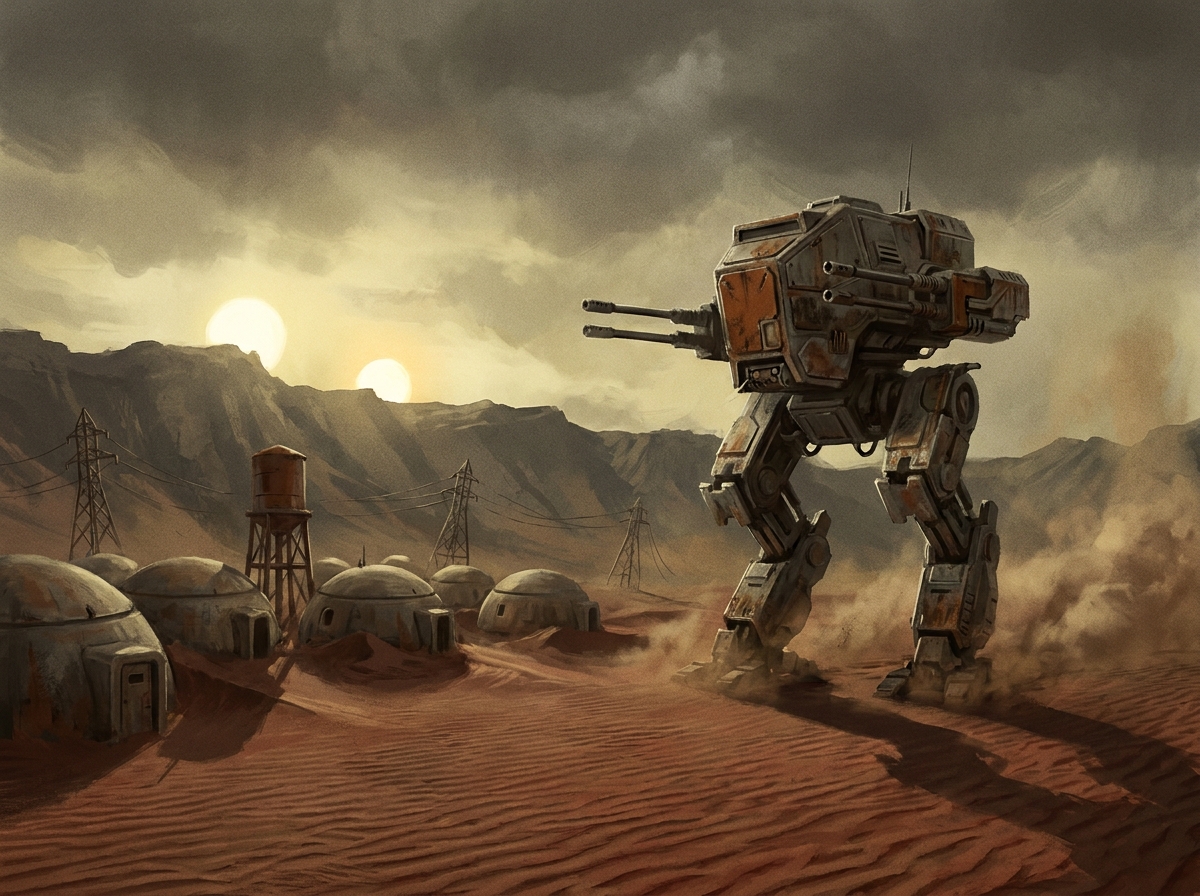
Six generations separate the arrival in 2259 from the founding of the Confederacy in 2323. Six generations in which stranded convicts became settlers, settlers became colonists, colonists became citizens — and the Nagglfar commander families became a hereditary dynasty. Tarsonis became the capital world. The Confederate Council became the facade. Behind the facade sat the Old Families, the descendants of the original ship officers, who had converted their privilege across generations into property rights, trade permits and military contracts. A democracy on paper. An oligarchy in practice — and that from day one.
Anyone interested in the human side of this history, not just the dates, should read Graham McNeill’s novel I, Mengsk (2008). It follows the Mengsk line from Angus to Arcturus and supplies the personal dimension to what happened on Korhal in 2491.
Three Power Blocks — Confederacy, Kel-Morian Combine, Umojan Protectorate
Three worlds, three ships, three social blueprints. The Confederacy on Tarsonis governed through political power and the military apparatus of the Confederate Armed Forces. The Kel-Morian Combine on Moria controlled raw-material extraction and left the Confederacy dependent on what it officially scorned. The Umojan Protectorate on Umoja kept its distance — scientifically advanced, politically isolationist, with a taste for unilateral decisions about its own borders.
The Guild Wars from 2485 to 2489 were the Confederacy’s attempt to subjugate the Combine economically. The outcome: a crooked armistice. The Combine kept its autonomy, but lost nearly all of its mining guilds to the Confederacy. Collateral damage: in 2489, Confederate Ghosts assassinated Angus Mengsk — senator, reformer, father of a son who would not forget it. The Umojan Protectorate formed in the same year, driven above all by the one-sided Guild Wars settlement and the Confederacy’s expansionist appetite; the murder of Angus Mengsk fit the pattern.
Korhal 2491 — The Ignition
Arcturus Mengsk was 25 when his father was killed. Two years later, he had understood that speeches and petitions are no answer to a government that liquidates senators. He founded the Sons of Korhal — an armed resistance movement that destabilised the Confederacy until Tarsonis responded.
The Confederacy’s response to the Sons of Korhal was not arrest. It was not negotiation.
„one thousand Apocalypse-class nuclear missiles“
StarCraft I Manual (1998)
One thousand Apocalypse missiles. Korhal, Mengsk’s homeworld, was erased by its own government in 2491. Canon puts the death toll at roughly four million. From that moment on, Arcturus Mengsk became what he would remain until his death: a man whose political agenda was anchored in the extinction of his entire world. And a man prepared to apply the same calculus to other worlds.
III. The Great War and Its Aftershocks
2499 — Chau Sara and First Contact
November 2499. Chau Sara, a Terran fringe colony at the outer edge of the sector. Zerg swarms emerge from interstellar space — without warning, without communication, without any discernible strategy beyond: assimilate. The Confederacy locks down information and tries to keep the situation small. What followed would not stay small.
8 December 2499. Tassadar, Executor of the Protoss expeditionary fleet, appears above Chau Sara and executes the Purification doctrine: the entire planetary surface is glassed. Zerg destroyed, colony destroyed, population destroyed. No contact, no warning. Four days later, when a Confederate fleet moves to hold the Protoss accountable, Tassadar withdraws. The Great War had begun — officially dated to 12 December 2499, marked by a fleet pulling back when it should have attacked.
2500 — Tarsonis and the Betrayal
February 2500. Arcturus Mengsk had built the Sons of Korhal into a serious fighting force with a single target: Tarsonis, the Confederate capital, the same government that had glassed Korhal. The method he chose to reach that target still defines his character.
Mengsk deployed psi-emitters — signal beacons that draw the Zerg Swarm. Not against military targets. Against Tarsonis itself. The Swarm fell on the capital, and while Confederate troops were ground down between Zerg waves and Sons of Korhal assaults, Mengsk left Sarah Kerrigan — Ghost operative, resistance fighter, trusted ally — stranded on the battlefield of New Gettysburg when the evacuation order came through. She was not collateral damage. Mengsk had factored her into the price in full knowledge.
The Overmind assimilated her. Sarah Kerrigan became the Queen of Blades.
Liberty’s Crusade (Jeff Grubb, 2001) captures, through the eyes of the journalist Michael Liberty, what the Zerg invasion meant for the ordinary Confederate citizen — the face of the fall of Tarsonis that inevitably becomes an abstract map in an RTS campaign. Anyone who wants to understand why the Confederacy was not simply „the evil government“ but a system with real people inside it will not get past this novel.
On Tarsonis, for the first time, all three factions fought in the same place at the same time. Not allied, not coordinated — just colliding. Mengsk’s Sons of Korhal, Kerrigan’s Zerg assimilators, Tassadar’s Protoss expeditionary force. The constellation that the StarCraft Tabletop Miniatures Game treats as its baseline state had its first historical manifestation here.
2500 — Aiur Falls
While Tarsonis burned, the Overmind opened its warp jump to Aiur. The Protoss homeworld, seat of the Khala, centre of a civilisation that had endured for millennia — the Zerg assault ran from 2500 to 2503 and killed 70 percent of the Protoss population on the planet.
„70 percent of the protoss population on Aiur was killed“
StarCraft: Brood War Manual
Tassadar returned. Not with a relief fleet, but with a conclusion drawn from his unsanctioned contact with the Dark Templar: the Overmind could only be destroyed by a fusion of Khala energy and Void energy — a combination the Khala-loyal Protoss regarded as heresy. Tassadar used his flagship Gantrithor as the weapon and sacrificed himself to destroy the Overmind. The Swarm fragmented, decentralised, went briefly chaotic. Not harmless — chaotic.
Protoss survivors fled through Warp Gates to Shakuras, the Dark Templar homeworld. Aiur remained Zerg-occupied, ruined, lost.
2500 — Brood War and the Queen of Blades
Before the ash had cooled, the United Earth Directorate arrived. An Earth expedition — from the original homeworld the supercarrier prisoners had once been deported away from — under Admiral Gerard DuGalle and Vice Admiral Alexei Stukov: well equipped, imperial in posture, with a plan to bring the Koprulu sector back under Earth control. They carried their own psi-emitter hardware and took temporary control of fragments of the Swarm.
Kerrigan allowed it, right up until it served her, and then assembled a coalition of Zerg broods, Raynor’s Raiders and Fenix’s Protoss to systematically dismantle the UED fleet. Admiral DuGalle died in retreat. Stukov had fallen earlier. The expedition ended in complete defeat. Kerrigan stood afterwards as uncontested ruler of the Swarm. Arcturus Mengsk had founded his Dominion with the bones of Tarsonis in its foundation. General Edmund Duke was dead. Of the major actors in the Great War, few had survived without significant cost — except Kerrigan, who used the costs of others as currency.
2504–2506 — The Trilogy of Collapse
2504: Jim Raynor, Raiders commander and former ally of Mengsk, recovered the Keystone artefact — a Xel’Naga object powerful enough to reverse Kerrigan’s infestation. The operation on Char succeeded. Sarah Kerrigan was de-infested on Char. What that meant for the Swarm was, at that point, still unclear.
2505: On Zerus, homeworld of the Zerg, Kerrigan underwent a transformation that turned her into the „Primal Queen of Blades“ — stronger than before, this time by her own will. Arcturus Mengsk died by her hand. His son Valerian took over the Dominion — a different Mengsk, with different intentions, but the same inheritance.
2506: Amon, returned from the Void and bound into a body through his Xel’Naga servant Narud, corrupted the Khala itself — the psychic bond that had held the Protoss together for millennia. Every Protoss connected to the Khala became Amon’s instrument. The response from Hierarch Artanis and the surviving free was radical: they severed their own nerve cords. The Khala, that fragile peace after the Aeon of Strife, was gone. Shakuras was detonated to wipe out a Zerg army. Artanis led the counter-offensive into the Void itself.
2508 — Into the Void and the State of the Sector
Kerrigan transcended. In the Void, the primal space the Xel’Naga had come from, she defeated Amon for good — not as Queen of the Swarm, but as Xel’Naga. What became of her afterwards, canon leaves open. What remained is clearer: Valerian Mengsk as ruler of the Terran Dominion, where reforms have started but the power structures of his father still work underneath. Artanis as Hierarch of a people without a shared psychic bond, forced to redefine what „Protoss“ means. Zagara as new leadership of the Swarm, trying to build something resembling order out of a race engineered for war.
The sector in 2508 is rebuilding. Aiur is still ruined. Korhal is still radioactive in memory. The faction lines are new, the enmities older than any living memory. That is the starting condition the StarCraft Tabletop Miniatures Game picks up in its rulebook — and the one the AMA with the Archon Studio developers confirmed as the played timeline.
Further Briefings
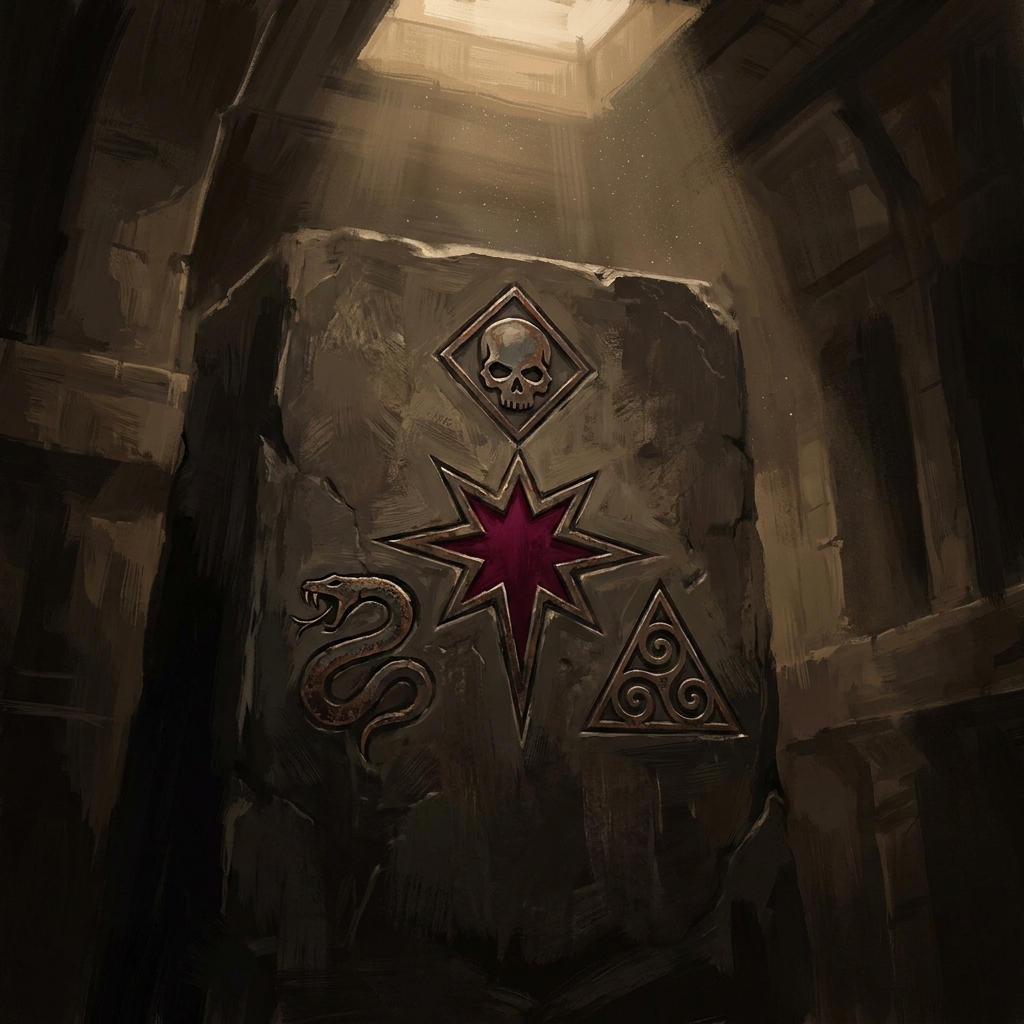
This briefing mapped the sector as a whole. The three parts that follow go deeper — each from a perspective that weights the shared history differently.
The Terrans are not a monolithic block. Mengsk’s Dominion and the Sons of the Confederacy he claimed to lead carry the original sin of their founding in every structure. Who are the Old Families today? How different is Valerian really? And why does Raynor’s Raiders legacy remain an open account that no peace treaty can settle?
The Zerg are not what is left when an Overmind dies. They are what emerges when a race biologically optimised for assimilation suddenly has to function without a central will. Zagara holds the broods together — but for how long, and on what terms? The anatomy of the Swarm explains why peace with the Zerg is not a treaty but an experiment.
The Protoss severed their greatest resource themselves. Khala, Void, Khalai, Nerazim, Purifier — these words do not describe factions within a species. They describe competing answers to the question of what holds a civilisation together when the bond that unified it became the enemy’s weapon. The Daelaam are a unity on paper. The next part shows how thin that paper is.
- Sons of the Confederacy — A Terran Chronicle
- The Swarm — Anatomy of a Predator
- Khala and Void — The Last Guardians
Part one stands by.